
For decades, standard advice for international diversification was simple. Buy a broad index and hold. However, the mid-2020s brought change. The developing world landscape has fractured into distinct power blocs. The definition of an “emerging market” has evolved. It is no longer just a simple bet on raw materials. Now, it represents a complex play on technology, demographics, and geopolitics.
The IMF projects developing economies will grow rapidly through 2026. This rate doubles that of advanced nations. Therefore, investors cannot ignore this asset class. You must understand two dominant frameworks to navigate this terrain. These are the traditional MSCI Emerging Markets Index and the rising BRICS+ alliance.
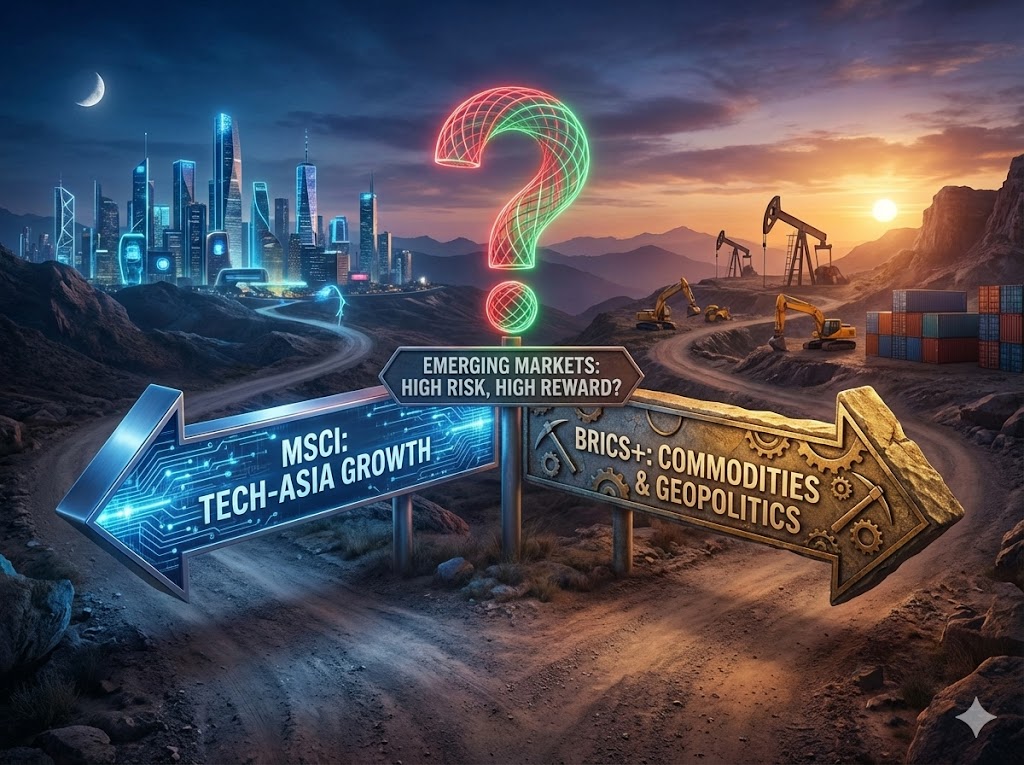
Defining Emerging Markets in 2025
Economists define an emerging market by its transitional state, not just GDP. These economies are moving away from low-income or agrarian models. They are shifting toward modernized, industrial, and digital infrastructures. Rapid industrialization and younger populations characterize them. Often, they exhibit higher volatility than developed markets.
Investing in emerging market indices has changed fundamentally. The focus shifted from commodities to consumers and microchips. India and Vietnam are becoming manufacturing hubs. Meanwhile, Middle Eastern nations are diversifying rapidly beyond oil.
The Benchmark: MSCI Emerging Markets Index
The MSCI Emerging Markets Index remains the gold standard for most investors. It acts as the yardstick for measuring active managers. It also serves as the template for trillion-dollar ETF assets.
Composition and Weighting Asia dominates the MSCI index. It accounts for over 70% of the weight. As of 2025, China, India, Taiwan, and South Korea lead the pack. This concentration makes the index a proxy for Asian growth. It does not represent a truly balanced global basket.
Sector Breakdown Many investors stereotype emerging markets as oil and mining plays. However, the MSCI index is surprisingly tech-heavy.
- Information Technology: This sector often claims the top spot. Semiconductor giants in Taiwan and South Korea drive it.
- Financials: Large banks in India and China provide significant weight. They offer exposure to the rising middle class.
- Consumer Discretionary: E-commerce giants in China and Latin America anchor this sector.
The MSCI Emerging Markets Index offers a “growth” profile. It resembles the Nasdaq but includes jurisdictional risk. Investors prefer this vehicle for exposure to future supply chains. It avoids concentrated bets on specific countries.
The Challenger: BRICS Composite Index
MSCI represents the financial establishment. In contrast, the BRICS alliance represents a geopolitical shift. The bloc originally comprised Brazil, Russia, India, China, and South Africa. It expanded significantly in 2024 and 2025. New members include Egypt, Ethiopia, Iran, the UAE, and Indonesia.
A Different Economic Flavor Indices tracking BRICS nations offer different exposure than the broad MSCI benchmark.
- Commodity Dominance: The group includes major oil producers like the UAE and Iran. It also features agricultural powerhouses like Brazil. Consequently, a BRICS portfolio leans heavily toward energy and natural resources.
- Geopolitical Hedge: The BRICS bloc creates a counterweight to G7 economic dominance. For investors, emerging market indices focused on BRICS serve as a hedge. They protect against the US dollar and Western trade policies.
- The “Global South” Consumer: This grouping captures the demographic explosion of the Global South. It does so more effectively than developed-market indices.
However, accessing a pure “BRICS Composite” is difficult. Western investors often face restrictions on Russian assets. Therefore, the “index” remains a theoretical construct or a basket of country-specific ETFs.
Risk vs. Reward in the Developing World
Emerging market indices attract investors with the potential for outsized returns. Higher GDP growth rates typically drive these gains. However, “high risk” accompanies this “high reward” potential.
The Currency Trap Currency volatility kills emerging market returns. Suppose a local stock market rises 10%. If the currency falls 15% against the dollar, a foreign investor loses money. The strength of the US dollar has been a major headwind recently. It eroded real returns in Turkey, Brazil, and South Africa.
Political and Regulatory Risk Emerging markets face sudden policy shifts. Governments may crackdown on tech sectors or nationalize resources. Sudden tax law changes can decimate portfolio value overnight. The BRICS bloc carries higher geopolitical risk. Some member nations hold anti-Western stances. This exposes investors to potential sanctions or trade wars.
Growth Potential Despite risks, the math favors the bold. Developed markets face aging populations and debt saturation. Thus, the growth differential is widening. The “demographic dividend” in India and Africa provides a massive labor base. Furthermore, valuations in emerging markets often trade at a discount. This offers a margin of safety for value-oriented investors.
Conclusion: Strategic Allocation
The question for modern investors is not “if” to invest, but “how.”
The MSCI Emerging Markets Index should serve as the core holding. It provides diversified, liquid exposure to high-growth economies. It is the safe way to play global growth.
However, believers in a “multipolar world” might add a satellite allocation. Funds focusing on specific BRICS markets enhance diversification. This approach captures resource-heavy upside that the tech-centric MSCI index might miss.
Investing in emerging market indices requires patience. You also need a stomach for volatility. But economic gravity is shifting south and east. Leaving these regions out of a portfolio may be the biggest risk of all.