
Technology is no longer just a sector. It is the fundamental architecture of the modern global economy. From the cloud servers powering banking to the algorithms curating entertainment, tech is omnipresent. Consequently, it has become the primary engine of capital appreciation for investors worldwide.
However, picking individual winners in this fast-moving landscape is notoriously difficult. Today’s giant can become tomorrow’s relic. Therefore, most investors turn to technology sector indices. These baskets of stocks provide diversified exposure to the innovation ecosystem. They allow you to bet on the trend without betting the farm on a single company.
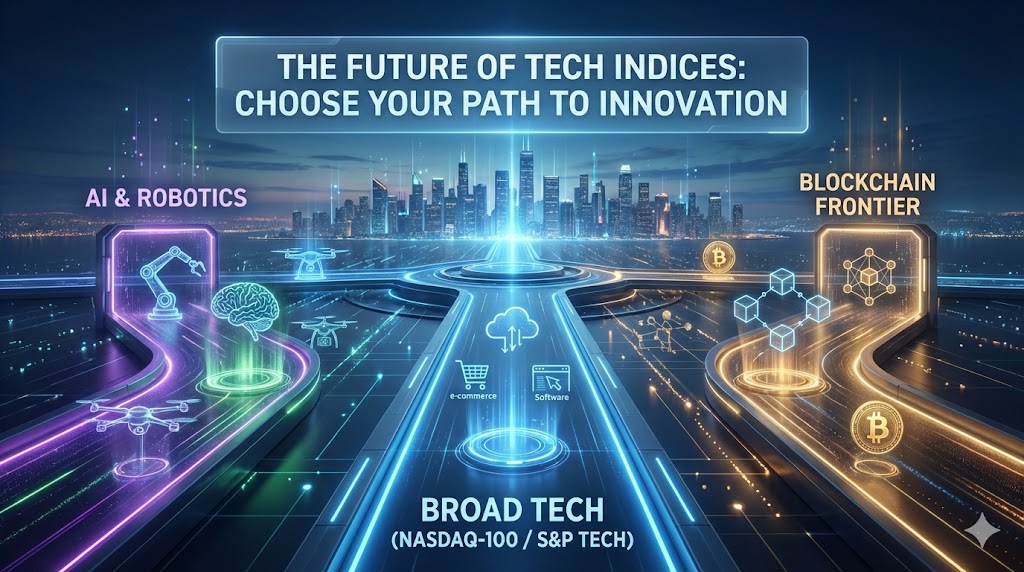
Broad Tech: NASDAQ-100 vs. S&P Technology Select
For general exposure, two giants dominate the landscape. These are the NASDAQ-100 Technology Sector and the S&P Technology Select Sector. While they sound similar, they offer vastly different exposures.
NASDAQ-100 Technology Sector The NASDAQ-100 is often synonymous with “tech.” However, the broader index includes retail and biotech. The specific Technology Sector sub-index filters out the noise. It focuses purely on the innovators.
This index captures the full spectrum of modern tech. It includes hardware, software, and importantly, internet commerce. It holds the “Magnificent Seven” and broader internet giants. If a company uses technology to disrupt an industry, it likely finds a home here. Thus, it offers a comprehensive view of the digital economy.
S&P Technology Select Sector This index follows the strict Global Industry Classification Standard (GICS). This methodology is rigid. Surprisingly, it excludes some of the world’s most famous “tech” companies.
For example, Alphabet (Google) and Meta (Facebook) fall under “Communication Services.” Amazon falls under “Consumer Discretionary.” Therefore, the S&P Technology Select Sector is highly concentrated. It leans heavily on classic IT. This includes software giants like Microsoft, hardware titans like Apple, and semiconductor leaders like NVIDIA.
Investors must understand this distinction. If you buy the S&P index, you miss out on social media and e-commerce growth. If you buy the NASDAQ index, you get a broader, but potentially more volatile, mix. Both technology sector indices serve as core portfolio building blocks.
Thematic Growth: AI & Robotics
Beyond the broad indices, “thematic” indices offer targeted exposure. These track specific disruptive trends. Currently, Artificial Intelligence (AI) and Robotics are leading this charge.
The AI & Robotics Index The convergence of AI and physical robotics is reshaping industry. Indices like the Index Global Robotics & Artificial Intelligence Thematic Index track this shift. They do not just buy the famous software companies. They also buy the “pick and shovel” plays.
These include Japanese industrial automation firms like Fanuc. They include Swiss sensor manufacturers. They also include the US chip designers powering the AI models. This ecosystem is vast.
- Industrial Automation: Robots building cars and electronics.
- Non-Industrial Robotics: Surgical robots and autonomous drones.
- Artificial Intelligence: The neural networks processing the data.
Investing here is a bet on a structural shift in labor. It assumes automation will continue to replace manual tasks.
The Blockchain Frontier
Blockchain represents another distinct theme. It is often misunderstood as simply “cryptocurrency.” However, technology sector indices focusing on blockchain look deeper. They track the equity of companies building the decentralized web.
The Blockchain Index or similar benchmarks track actual corporations. These companies hold digital assets or build the infrastructure for them. This includes crypto exchanges like Coinbase. It includes Bitcoin mining operations. It also includes traditional banks developing private ledgers.
This sector is highly speculative. It correlates strongly with the price of Bitcoin. When crypto winter hits, these indices suffer disproportionately. However, during bull markets, they offer explosive growth potential. They serve as a high-octane satellite position for aggressive portfolios.
Volatility: The Price of Admission
High returns rarely come without high risk. Technology sector indices are inherently volatile.
Interest Rate Sensitivity Tech stocks are “long duration” assets. Their value relies on earnings expected far in the future. When interest rates rise, those future earnings are worth less today. Consequently, tech stocks often sell off sharply during periods of monetary tightening.
The Hype Cycle Innovation triggers hype. Investors often bid up thematic indices to unsustainable valuations. We saw this with the Dot-com bubble. Prices can detach from fundamentals. Eventually, mean reversion occurs.
managing the Swings Diversification is your primary defense. Broad indices like the NASDAQ-100 smooth out the bumps. If one software company fails, another takes its place. Thematic indices (AI or Blockchain) are riskier. They should occupy a smaller percentage of your allocation. A “core and satellite” approach works best. Use a broad index as your core. Use thematic indices as smaller satellites for extra growth potential.
Conclusion: Capturing the Future
The world is not going back to analog. The digitization of the economy is a one-way street. Therefore, technology sector indices belong in almost every long-term portfolio.
The choice depends on your precision.
- Broad Exposure: Stick to the NASDAQ-100 or S&P Technology Select. These cover the titans of industry.
- Targeted Growth: Look to AI and Robotics indices. These capture the next industrial revolution.
- Speculative Upside: Blockchain indices offer high-risk, high-reward exposure to decentralized finance.
Understanding the methodology matters. Know what your index holds. Know what it excludes. By doing so, you can harness the power of human innovation to drive your personal wealth.